Korean Matter solution provider What’s Matter Inc. just saw a vibration sensor certified, marking an innovative option for multipurpose use with Thread connectivity. This is our first look at a native Matter vibration sensor, which suggests we can expect new products powered by this pre-built solution soon.
What is certified?
The vibration sensor itself is not defined by the Matter standard yet, but its nature as a binary sensor allows it to be represented by many device types. For the certified unit from What’s Matter Inc., it adopted a contact sensor as the Primary Device Type according to the certification details.
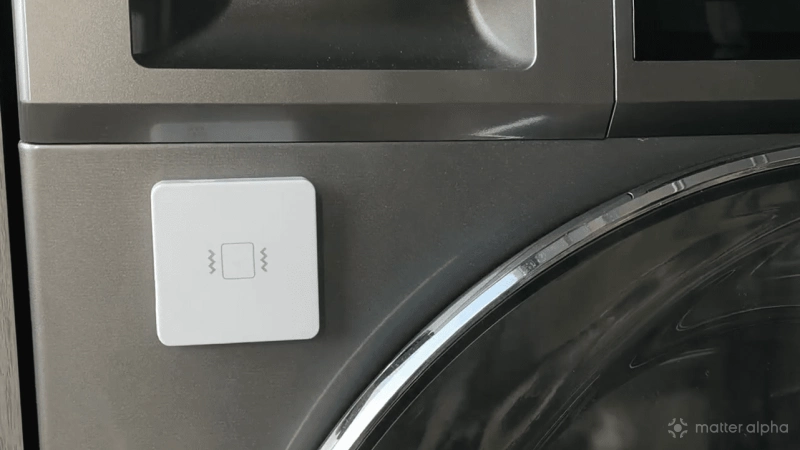
This vibration sensor detects shocks and vibrations in real time to allow users to quickly identify unusual events. It can be installed on various objects such as windows, safes, and appliances to detect intrusion attempts or abnormal movements. The device is also useful for monitoring the condition of machinery. It supports wireless connectivity via Thread to integrate with smart home systems and sends alerts to enhance security and safety.
The compliance files show a minimal set of clusters and features. The device is certified under Matter 1.4 and can report a basic boolean state of on or off. It does not support optional configurations like sensitivity or on-hold time that we have seen in similar binary sensor devices.
The sensor would be set up via Bluetooth and maintain Thread connectivity once set up successfully. As Matter requires, the device would have an “Identify” button exposed to help users navigate the device using an LED indicator or sound. The compliance file also suggests it supports Matter OTA.
As of the press time, the firm has yet to response to Matter Alpha’s inquiry for details.
Basic Matter can be creative
Matter can barely cover niche device types without the contribution of participants to the spec, which is a requirement in both development and finance. However, most complex or niche device types can be split and abstracted as basic elements like binary sensors, on/off switches, level controls, and mode selections.
Taking vibration sensors as an example, they were a unique device category that could previously be found in Zigbee and Z-Wave versions from brands like Aeotec, Aqara, ThirdReality, and Tuya. Integrating these into Matter required a bridge, and the experience has been inconsistent due to the lack of a standard device type. Bridges have had to get creative to make these sensors visible to platforms like Apple Home or Google Home.
For instance, some bridged options like those from Aqara are exposed as an occupancy sensor to trigger automations based on movement. In other scenarios, similar to how water leakage detectors are often mapped as contact sensors to ensure compatibility, vibration sensors might appear as door sensors that “open” when vibration is detected.
In theory, developers can map the device features to standard Matter clusters. Since most basic device types are supported by major platforms, they should have a slightly experienced compromise in trade of controls via Matter locally across platforms. In the end, on top of the Matter compliance, it is a decision from the vendor if they want a feature exposed to Matter.
(Source: CSA, What’s Matter Inc.; Image Source: ThirdReality)