Arguably the best thing about Matter is that it aims to end the fragmentation of smart home and Internet of Things (IoT) hardware. Billions of devices are available with smart connectivity, but not all speak the same language, and Matter aims to solve the problem. It’s fair to say that while progress has been slow, things are improving in that regard.
But smart and IoT hardware have another important fragmentation issue, namely security. Regional regulations about how device security should work, and protect the users and networks, differ considerably. As with Matter, the Connectivity Standards Alliance (CSA) has proposed a solution, a common scheme that streamlines productivity into a single certification.
Security matters as much as interoperability
Interoperability and integration makes IoT and smart home gear seem almost magical. Lights come on when you enter a room, a robot cleaner can initiate a specific cleaning routine when another room is vacated, curtains can close or open based on temperature as well as time.
Each of the devices involved in integrations like these examples have gone through various types of certification. You’ve got the Wi-Fi radio, the power demands, compatibility with a smart home ecosystem, an app that runs on all maintained mobile operating systems, and yes, Matter.
There’s also the matter of security. So, the CSA has introduced a new Product Security Certification Program.
As with other streamlined certification programs, the aim is to satisfy regulations around the world with a single certification. This affords developers more time for development, less time to market, and less duplication of testing. IoT becomes stronger, and more products get to complete their development rather than be abandoned due to repeated testing costs.
Reusable certification artifacts
This video explains more:
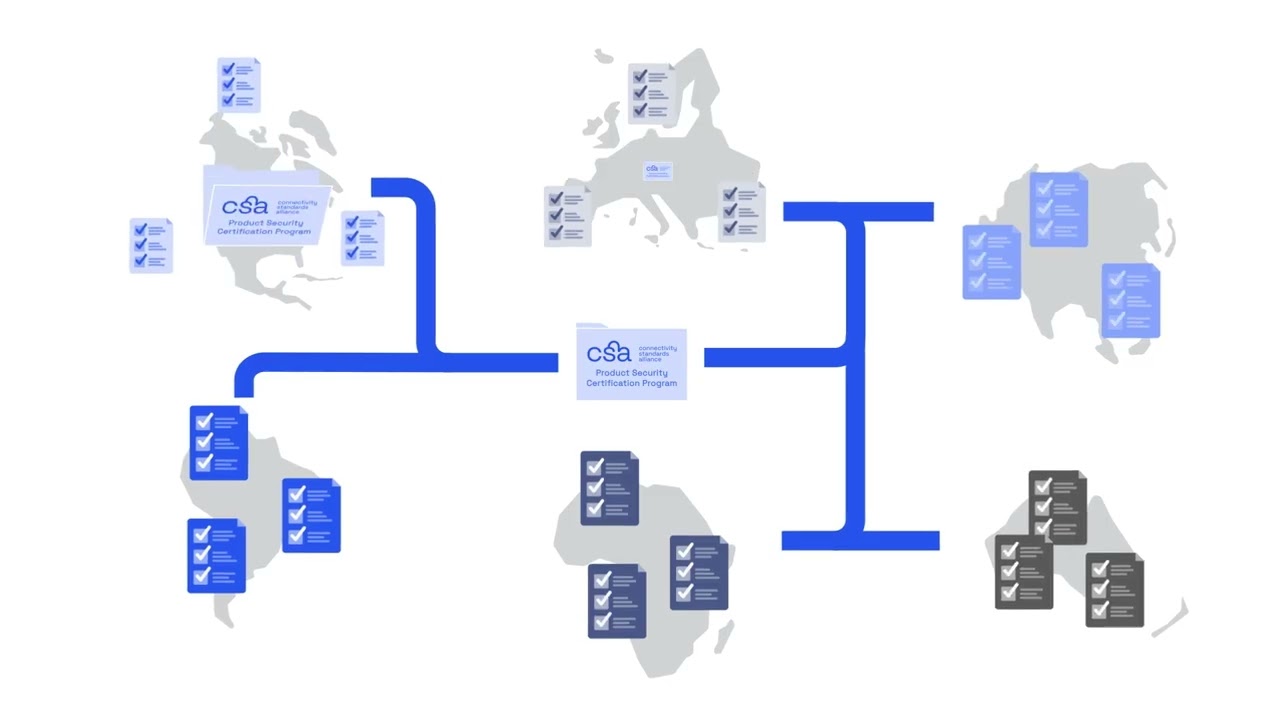
There is more to certification than simple checking a box. It is designed to be extensible, with new requirements added without a complete overhaul of the compliance process. So, companies now and in the future can design products with a global focus on the security, rather than tweaking or retrofitting for different markets.
Rather than the different compliance regulations acting as a roadblock to progress, they can be unified into a more streamlined and efficient process with reusable artifacts for certification. So, rather than the old method of what might be described as “siloed compliance” – undergoing multiple testing processes (probably largely identical, but with differing paperwork) – reusable certification artifacts become almost a unit of currency. Rather than a sort of "compliance tax" of costly, repeated global regional testing, the manufacturer uses the Alliance’s standard to run the tests, with the design documentation, pass/fail results, security code audits, and vulnerability scan results submitted as supporting evidence.
The game changer you thought was already happening
It is incredible to think that tech hardware manufacturers go through so much testing around the globe in order to meet local requirements. The Connectivity Standards Alliance has already had success with Zigbee and Matter, and collaborated with the Wi-Fi Alliance toward similar aims.
So, we can be pretty confident that this process will deliver the resilient security testing that smart home and IoT hardware needs.
(Image: Alexander Dummer)