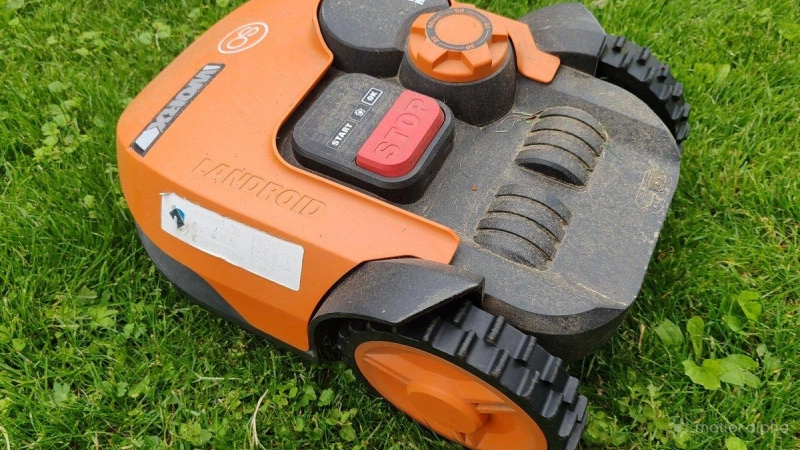
Whether you have a compact lawn or a sprawling garden of grass around your home, some days you just want to relax without firing up the mower. You might have an electric, a push mower, a battery-powered grass-cutter, or prefer the pleasure of a gasoline mower.
But robot mowers have improved considerably over the past five years, and are becoming a popular addition to many homes. With Matter-compatible pergolas, water management, smart plugs, and even external lighting, it seems strange that one of the most important tools for the garden isn’t covered by a Matter device specification.
So, isn’t it time for Matter to add support for robot mowers?
Robot grass cutters can now mow the lawn without you
When I first bought a robot vacuum cleaner, the device had a key limitation: it couldn’t stop unless there was a barrier. This might seem useful for small rooms, but is less practical in open-plan homes. On offer, though, was a solution: adhesive strips of magnetic material that would act as a border. Thankfully, thanks to cameras and LiDAR technology, this is no longer a problem, and robot cleaners can go exactly where you tell them to.
Robot lawn mowers have been similarly afflicted, but the solution came much later. For years, robot grass cutters could easily destroy your rhododendrons if you omitted to bury a powered wire under the grass. This acted as a barrier – best positioned next to your flower border – and as long as it remained functional, the grass cutter would not start taking cuttings from your flower beds.
That is, unless it was chewed through by the local rodent population.
Of course, robot mowers have had other challenges, such as terrain, sticks, much left by pets and wildlife, etc., but the key challenge has been in navigation and boundaries. Even now, it is not perfect, with LiDAR and GPS working well in open air, but less accurately under trees or bushes.
The Matter device specification problem

EcoVacs, Dreame, Anker/Eufy, and Bosch all produce robot lawn cutters, and are all members of the Connectivity Standards Alliance, the cross-industry body that determines what devices will be supported in Matter, and to what extent.
Interestingly, all four of these companies also produce robot vacuum cleaners, and we have seen the functionality of robovacs expand with subsequent release of Matter. So, what is the hold up with robot grass cutters? Why can’t you automate your smart lawn mower with Matter this summer?
As things stand, the Matter Application Cluster Library lacks specific instructions for robot lawn mowers. This is a repository of functionalities that acts as a sort of blueprint for smart home tech to work with Matter. A cluster consists of attributes, commands, and events, and typically applies power, control, measurement, sensing, and onboarding capabilities to a device.
Currently, the Matter Application Cluster Library doesn’t have the necessary commands and parameters that are required for a robot lawn mower. While movement and mapping may seem to be similar to robot cleaners, lawn mowers have other factors to consider. Think blade height, edge trimming, emptying, different maintenance routines, and even safety concerns, like the position of the blades.
A Matter-compatible smart lawn mower is an intriguing proposition. Integration with other smart home devices, whether sensors or sprinklers, offers impressive automation, but this is something that needs a lot of work to implement safely.
Happily, we’re seeing movement in this direction beyond Matter, and other companies with an interest in robot lawn cutters – Grimsholm Green, Gardena, and Husqvarna – are also members of the CSA.
A growing market for garden automation

One of the more interesting trends in the Matter space over the past couple of years has been the migration from indoor automation to outdoor. It kicked off with Matter-compatible smart power outlets, moved onto water pumps and delivery systems for sprinklers, and even included structures like pergolas.
Matter 1.5 introduced support for soil moisture sensors and smart watering valves, while Matter 1.6 enabled standard control over closures, gates, and garage doors. Outdoor lighting is popular, of course, but really doesn't require any special support that indoor lights don't already have.
All of this, of course, makes perfect sense. A smart home is only as smart as the area it covers, and by encompassing garages, gardens, and outbuildings, the benefits of automation, integration, and security can be experienced in a more complete way. Better automations and integrations can be enjoyed, giving you more time to enjoy the garden, rather than work in it.
There is little point in adding smart tech to things that don’t need it, so it is unlikely we’ll see a smart pruning device anytime soon. (Having said that, smart mowers may well evolve into general garden maintenance users in the way robovacs have progressed into mopping and self-cleaning). However, a smart robot grass cutter makes sense, and if set up correctly, has the potential to bring an end to one of the most tedious (or enjoyable) tasks in the garden.
But at the time of writing, there is no way to integrate a robot lawn mower into your smart home’s Matter environment. Some cross-platform automations are possible, but Matter is not a factor.
When will Matter support robot lawn mowers?
As with everything Matter, robot lawn mowers will not be supported until they are added as a device to the specification. While robot lawn mowers can be brought into an automation environment with Home Assistant, other platforms are lagging behind.
The similarities between robot lawn mowers and robot cleaners are clear, and it may well be the case that adding this device type to Matter is largely straightforward. But it could also be something that is added slowly – as robovacs were – and subject to observation ahead of wider features being supported.
One thing is clear, however: smart garden tech is part of the smart home, and robot lawn mowers – like pergolas and water pumps and smart outlets – will almost certainly become part of the Matter experience at some point.
(Image credit: Janez Temlin/Pexels; Pixabay/Pexels)