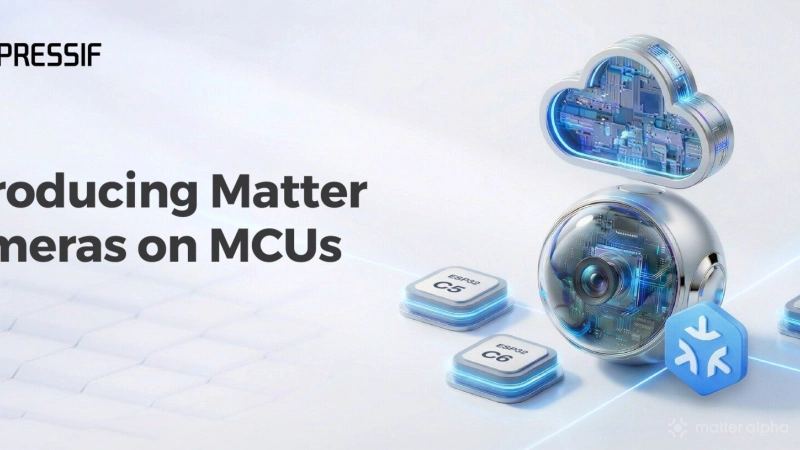
Notable IoT chipset maker Espressif Systems has officially launched the industry’s first microcontroller-level Matter camera solution running on a real-time operating system. Based on the ESP32-P4 chipset, this new offering aims to help manufacturers and developers create smart home cameras that integrate directly into the Matter ecosystem, following the standard’s expansion into camera devices with version 1.5.
Given Espressif’s strong standing in the community, this release is expected to accelerate the development of “flash-to-deploy” projects like ESPHome and Tasmota.
Architecture and performance
The solution utilizes the ESP32-P4 as the primary application processor. This chip is responsible for handling camera input, multimedia processing, artificial intelligence inference, and overall system control. For wireless connectivity, the system pairs with the company’s companion system-on-chips (SoC), such as the ESP32-C6 or ESP32-C5. This split architecture allows manufacturers to scale computing power and connectivity independently, offering flexibility for various device form factors.
The platform also supports wired connections via Ethernet for security setups.
By utilizing a microcontroller architecture rather than a traditional Linux-based system, the solution offers distinct advantages for the smart home market. It features significantly lower power consumption, making it well-suited for battery-operated devices like wireless video doorbells. Also, the simplified architecture presents a smaller attack surface for improved security and enables faster boot speeds, allowing the camera to wake up and record quickly when motion is detected.
Capabilities
The platform currently supports full high-definition video capture at 1920x1080 (1080p) resolution at 30 frames per second, utilizing hardware H.264 encoding for efficient compression. It enables real-time audio and video streaming via WebRTC and includes support for two-way audio communication. The system is designed to handle multiple video streams simultaneously, a critical requirement for modern monitoring interfaces.
Developers can test the software using an ESP32-P4 verification board equipped with a MIPI-CSI camera module. The necessary code is available through the company’s camera example repository, requiring only a compatible Matter controller for commissioning.
Features on the way
Espressif has outlined several upcoming features to further align with the Matter 1.5 specification. Future updates will introduce support for JPEG snapshots and encrypted media recording using the Common Media Application Format. The company also plans to implement privacy and control features, including Pan-Tilt-Zoom capabilities and support for defining Cartesian coordinate zones.
As the smart home market adopts the latest Matter specifications, this MCU-based approach positions itself as a cost-effective and secure alternative to the resource-heavy camera architectures currently in use. The standardization of device models and secure communication protocols ensures that these cameras can interoperate seamlessly across different platforms, reducing the fragmentation that has historically plagued the smart home video market.
The move is significant because it lowers the barrier to entry for creating compliant home video devices. Traditionally, building a secure, cloud-connected camera required complex Linux implementations and heavy processing power. By streamlining this onto a microcontroller running an RTOS, Espressif is populating the tech, potentially leading to a wave of affordable, Matter-native video doorbells and security cameras in the coming year with Wi-Fi 6 and 6E support.
As of now, SmartThings is the only platform that supports Matter Cameras.
(Source: Espressif)